The numbers published in recent months by Cloudflare, Zayo, and StormWall tell a consistent story: DDoS attacks are no longer a niche threat aimed at gaming servers or activist targets. They have become a standard operational risk for any organization with internet-facing infrastructure — including mid-sized businesses that historically assumed they were too small to be worth targeting.
The Scale Has Changed Fundamentally
In 2025, global DDoS incidents surged 121%, reaching 47.1 million attacks according to industry tracking data. That works out to roughly 5,376 attacks mitigated every hour, around the clock. The record-breaking attack recorded in December 2025 peaked at 31.4 Terabits per second — a volume capable of disrupting entire national internet infrastructures.
Zayo’s 2026 Cybersecurity Insights Report adds another dimension: individual attacks are growing 70% larger in terms of bandwidth, even as total attack counts stabilize from their 2024 peaks. The implication is clear — attackers are shifting from spray-and-pray volume tactics toward fewer, heavier, more precisely targeted campaigns.
Government entities saw their share of total attacks more than double year-over-year, rising from 5% to 12% of all incidents. But enterprises of all sizes are increasingly in the crosshairs.
Multi-Vector Attacks Are Now the Norm
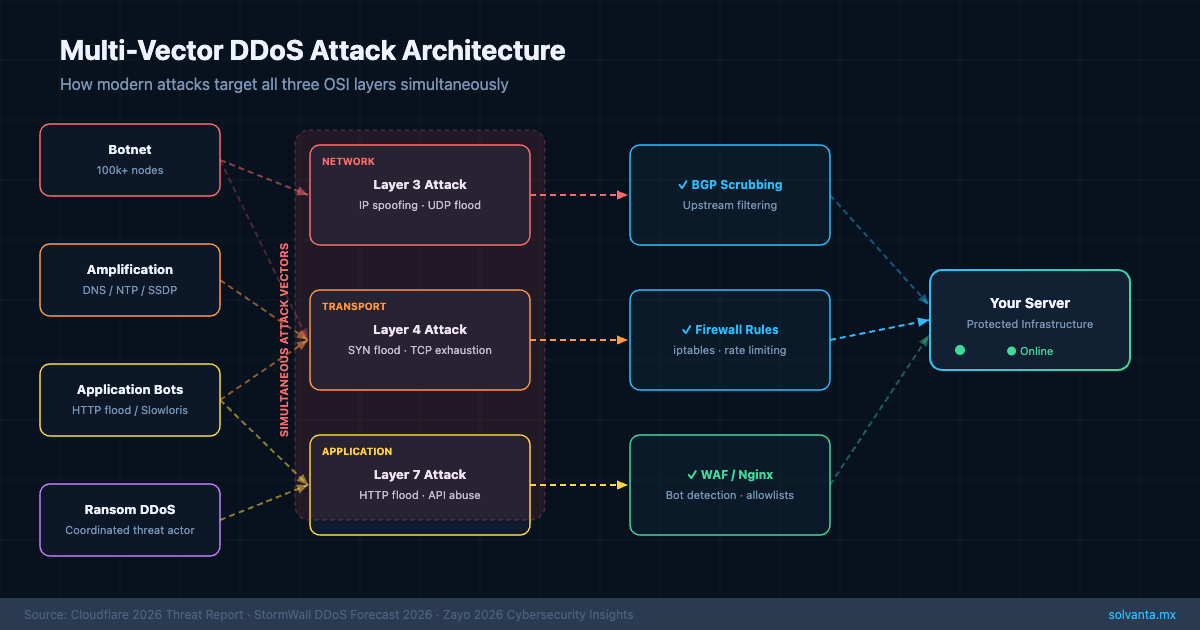
One of the more operationally significant shifts is the rise of multi-vector attacks. In 2025, the number of multi-vector incidents increased by 83%, and in nearly one-third of all DDoS cases, attackers combined two or more vectors simultaneously — hitting Layer 3, Layer 4, and Layer 7 at the same time.
This matters because most organizations protect each layer independently. A firewall handles network-layer traffic. A WAF handles application-layer requests. Rate limiting sits somewhere in between. When each tool operates in isolation, a coordinated multi-vector attack can find the gaps between them. What blocks at L3 passes through at L7, and vice versa.
StormWall’s 2026 forecast projects that multi-vector attacks could account for up to 65% of all incidents this year. The same report forecasts up to 58 million total DDoS events — nearly three times the 2025 figure. Their assessment: becoming a target is no longer a question of if, but when.
DDoS as a Smokescreen
Perhaps the most important trend for infrastructure teams to internalize is the growing use of DDoS as a distraction technique. Cloudflare’s 2026 Threat Report explicitly flagged this shift: attackers are increasingly using volumetric floods to draw IT attention away from simultaneous intrusion attempts happening elsewhere on the network.
The pattern is calculated. While your team is watching dashboards spike and scrambling to maintain uptime, a separate attack thread is probing for lateral movement, credential theft, or data exfiltration. By the time the DDoS wave is mitigated, the secondary breach may already be complete — and may go undetected for days or weeks.
This changes how incident response should be structured. A DDoS alert is no longer just a traffic problem to solve. It should trigger a broader security posture check across your entire perimeter.
The Cost Math
Current industry estimates put the cost of a successful DDoS breach at approximately $22,000 per minute in direct revenue loss. A twenty-minute outage — shorter than most mitigation cycles — approaches half a million dollars in immediate impact, before accounting for reputational damage, customer trust erosion, or regulatory exposure.
Ransom DDoS has returned as a serious threat model precisely because attackers understand this math. Ransom demands are increasingly priced just below the estimated cost of sustained downtime — a deliberately rational calculation that makes payment feel like the cheaper option.
What Effective Mitigation Actually Requires
Effective DDoS defense in 2026 is not a single product or a single configuration. It requires layered controls that work together: upstream traffic scrubbing to absorb volumetric floods before they reach your network, firewall rules that enforce rate limiting and geo-blocking at the edge, application-layer protection that distinguishes legitimate requests from bot traffic, and alert correlation that flags DDoS events as potential precursors to broader intrusion attempts.
Critically, it requires that someone tests these controls before an attack — not during one. Rules that looked correct on paper frequently fail under the actual traffic patterns of a real attack. The only way to know your mitigation works is to simulate it under controlled conditions.
At Solvanta, we design and implement DDoS mitigation strategies that span all of these layers — from iptables and Nginx rate limiting at the server level, to BGP-based scrubbing for high-volume floods, to firewall policy reviews that identify gaps before attackers find them. If your current setup has not been tested against a realistic attack scenario, it is worth having that conversation before the test happens on an attacker’s schedule.